Tutorial
Advanced Laravel Eloquent Relationships
L
Laravel Guru
8 min read
LaravelEloquentDatabase
Advanced Laravel Eloquent Relationships
Laravel's Eloquent ORM provides powerful tools for managing database relationships. In this comprehensive guide, we'll explore advanced relationship patterns that will make your Laravel applications more efficient and maintainable.
Understanding Polymorphic Relationships
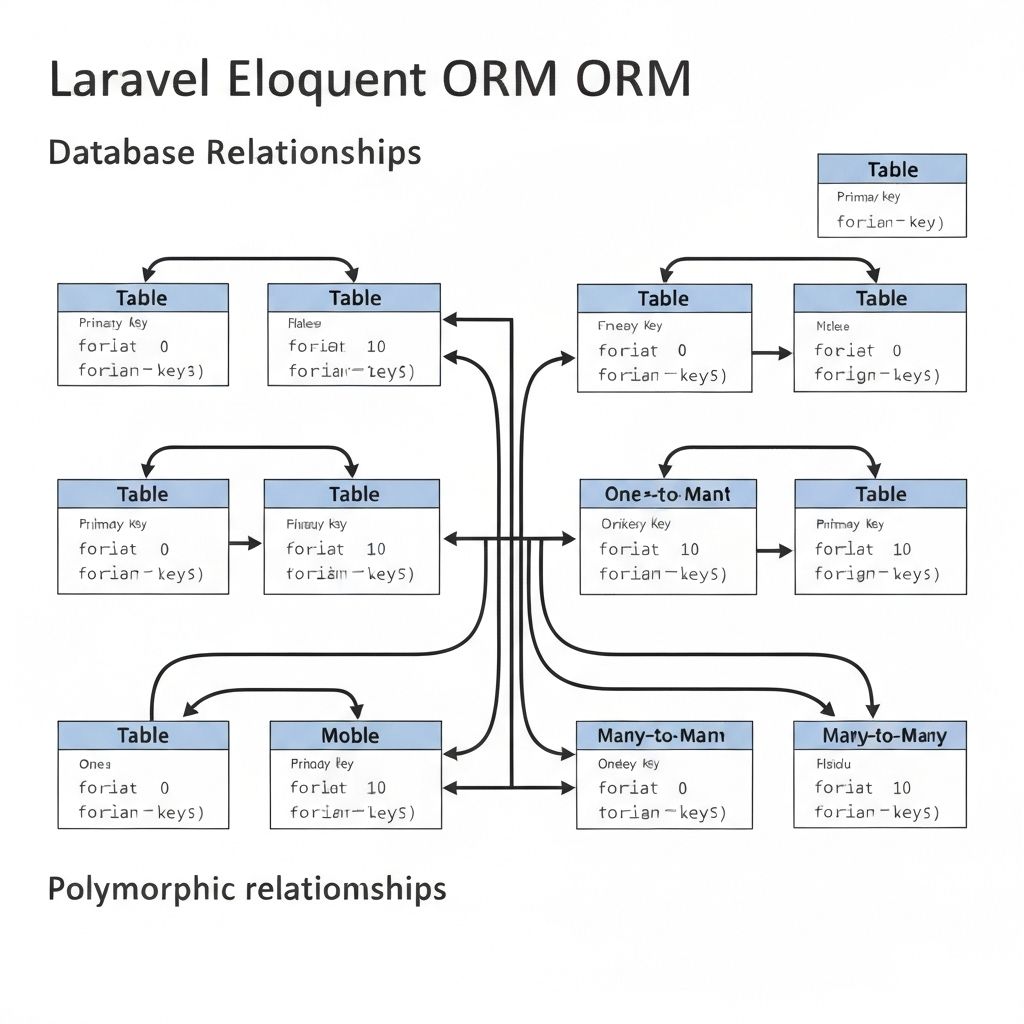
Polymorphic relationships allow a model to belong to more than one other model on a single association. This is particularly useful when you have models that can be associated with multiple other models.
// Example: Comments that can belong to both Posts and Videos class Comment extends Model { public function commentable() { return $this->morphTo(); } } class Post extends Model { public function comments() { return $this->morphMany(Comment::class, 'commentable'); } }
Eager Loading Optimization
One of the most common performance issues in Laravel applications is the N+1 query problem. Here's how to solve it:
// Bad: N+1 queries $posts = Post::all(); foreach ($posts as $post) { echo $post->author->name; } // Good: Eager loading $posts = Post::with('author')->get(); foreach ($posts as $post) { echo $post->author->name; }
Advanced Query Techniques
Laravel provides many advanced querying capabilities:
// Conditional relationships $posts = Post::with(['comments' => function ($query) { $query->where('approved', true); }])->get(); // Counting related models $posts = Post::withCount('comments')->get(); // Has relationship queries $posts = Post::has('comments', '>', 5)->get();
This is just the beginning of what you can achieve with Laravel Eloquent relationships!
Related Posts

Tutorial
Building Scalable APIs with Laravel Sanctum
Learn how to create secure, scalable APIs using Laravel Sanctum for authentication and authorization in modern web applications.
LaravelAPIAuthentication
By Laravel Guru
6 min read
Tutorial
Laravel Blade Components Deep Dive
Explore the power of Laravel Blade components for creating reusable, maintainable UI elements in your applications.
LaravelBladeComponents
By Laravel Guru
12 min read
Tutorial
Testing Laravel Applications Like a Pro
Master Laravel testing with PHPUnit, feature tests, and best practices for maintaining reliable applications.
LaravelTestingPHPUnit
By Laravel Guru
15 min read